Skip to content
  • Homework

    Spellings Checks in Year 2

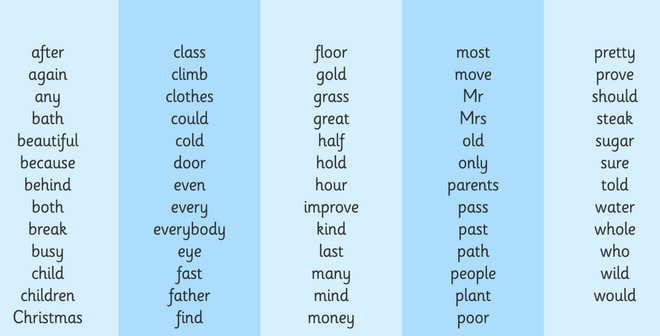
    Each Friday, we will check spellings linked to that week's Rocket Phonics learning, so the sounds/words should be familiar to the children.  Some weeks, the children will also have Year 2 Common Exception Words (CEWs) to learn, see below.  Thank you.

    Term 3


    Week 1: Spellings for Checking on Friday 9th January

    Phoneme: /or/Graphemes: or, au, aw, ar

    1. morning
    2. stories (NB. "Change the y to an i and + es")
    3. Autumn
    4. yawning
    5. quarter
    6. towards


    Week 2: Spellings for Checking on Friday 16th January

    Phoneme: /or/

    Graphemes: our, oor, ore, augh

    1. fourteen
    2. brought
    3. wore
    4. shore
    5. outdoors
    6. floor
    7. caught
    8. taught

    Common Exception Words:

    1. new
    2. who


    Week 3: Spellings for Checking on Friday 23rd January 

    Phoneme: /ur/

    Graphemes: ur, er, ir, ear, or

    1. purple
    2. remember
    3. thirteen
    4. third
    5. pearl
    6. earth
    7. worm
    8. worth
    9. working 

    Common Exception Words: n/a


    Week 4: Spellings for Checking on Friday 30th January 

    Phoneme: /ou/ + /oi/

    Graphemes: ou, ow, oi, oy

    Note: Lots of these words have the _ing suffix.

    1. around
    2. mountain
    3. counting
    4. frowning
    5. spoiling
    6. joining
    7. enjoying
    8. annoying

    Common Exception Words: n/a


    Week 5: Spellings for Checking on Friday 6th February

    Focus: Contractions

    1. couldn't 
    2. shouldn't
    3. wouldn't
    4. don't
    5. can't
    6. that's
    7. hasn't
    8. you're
    9. you've
    10. they're

    Common Exception Words: n/a


    Week 6: Spellings for Checking on Friday 13th February 

    Focus: suffixes -er, est, ing, ed

    1. happier (change the y to an i and add ed)
    2. funnier                        
    3. happiest (change the y to an i and add ed)
    4. funniest
    5. flying (just add ing)
    6. replying
    7. replied (change the y to an i and add ed)
    8. tried 

    Common Exception Words: n/a

    Term 2


    Week 1: Spellings for Checking on Friday 31st October

    Focus: w, wh + f, ff, ph 

    (Notice suffixes _ing + _ed below; these are revisited throughout Year 2)

    1. walking
    2. where
    3. whispered
    4. from
    5. huffed
    6. phone

    Common Exception Words:

    1. behind
    2. find


    Week 2: Spellings for Checking on Friday 7th November

    Phoneme: long oo

    Graphemes: u_e, ou, ue, ew 

    1. afternoon
    2. rules
    3. group
    4. rescue
    5. knew

    Common Exception Words:

    1. mind
    2. kind


    Week 3: Spellings for Checking on Friday 14th November

    Phoneme: 'y+oo'

    Graphemes: u, u_e, ue, ew

    1. unicorn
    2. costume
    3. few

    Common Exception Words:

    1. wild
    2. child
    3. eye
    4. climb


    Week 4: Spellings for Checking on Friday 21st November

    Phonemes: short oo + ar

    Graphemes: oo, u, oul + ar, a, al

    1. football
    2. pushed
    3. shouldn't
    4. couldn't
    5. started  (note _ed suffix)
    6. sharpened (note _ed suffix)
    7. after
    8. calm


    Week 5: Spellings for Checking on Friday 28th November

    Focus in class: Possessive Apostrophes (singular)

    This week, we will be learning how to use singular possessive apostrophes, eg. The dog's ball.  I have decided not to check the children's understanding of possessive apostrophes; instead, we will focus on spelling some of the Year 2 Common Exception Words.

    NB.  Sometimes, when children learn about possessive apostrophes, they start to incorrectly use the apostrophe for a plural (eg. The dog's were running) and this is something which I will teach them this week.  

    Spellings

    1. most
    2. only
    3. both
    4. clothes
    5. old
    6. cold
    7. gold
    8. told
    9. hold


    Week 6: Spellings for Checking on Friday 5th December

    Focus: suffix _es

    'Change the y to an i and +es'

    1. tries
    2. replies
    3. parties
    4. stories
    5. hobbies
    6. cities


    Week 7: Spellings for Checking on Friday 12th December 

    Revision of Term 2:

    1. where
    2. wheel
    3. blue
    4. rescue
    5. few
    6. football
    7. after
    8. dolphin
    9. Mum's (correct use of the apostrophe + s for possession)
    10. cries  (suffix _es)

    Term 1

    Spellings for Checking on Friday 12th September 2025

    Phoneme: /ee/

    Graphemes: ee, ea, e_e, ie, y, ey 

    1. been
    2. beach
    3. scene
    4. field
    5. happy
    6. donkey

    Common Exception Words:

    1. great
    2. steak


    Spellings for Checking on Friday 19th September

    Phoneme: /igh/

    Graphemes: igh, i, i_e, ie, y

    1. light
    2. child
    3. shine
    4. pie
    5. why

    Common Exception Words:

    1. break
    2. again


    Spellings for Checking on Friday 26th September

    Phoneme: /oa/

    Graphemes: oa, o_e, ow, oe, o

    1. float
    2. globe
    3. flow
    4. toe
    5. focus

    Common Exception Words:

    1. any
    2. many


    Spellings for Checking on Friday 3rd October

    Focus: Homophones

    1. blue
    2. blew
    3. pair
    4. pear
    5. here
    6. hear

    Common Exception Words:

    1. money
    2. people


    Spellings for Checking on Friday 10th October

    Focus: Suffixes _s and _es 

    (If the word ends in ch, sh, s, x, or z then add _es)

    1. friends
    2. apples
    3. glasses
    4. boxes
    5. matches
    6. splashes

    Common Exception Words:

    1. every
    2. everybody


    Spellings for Checking on Friday 17th October

    Focus: Suffixes _ed, _ing and _er 

    NB. These suffixes will be revisited several times throughout Year 2 and the children will be expected to start using them correctly in their independent writing.  

    1. painted
    2. painting
    3. looked
    4. looking
    5. colder
    6. taller

    Common Exception Words:

    1. busy
    2. because ('big elephants can always understand small elephants')